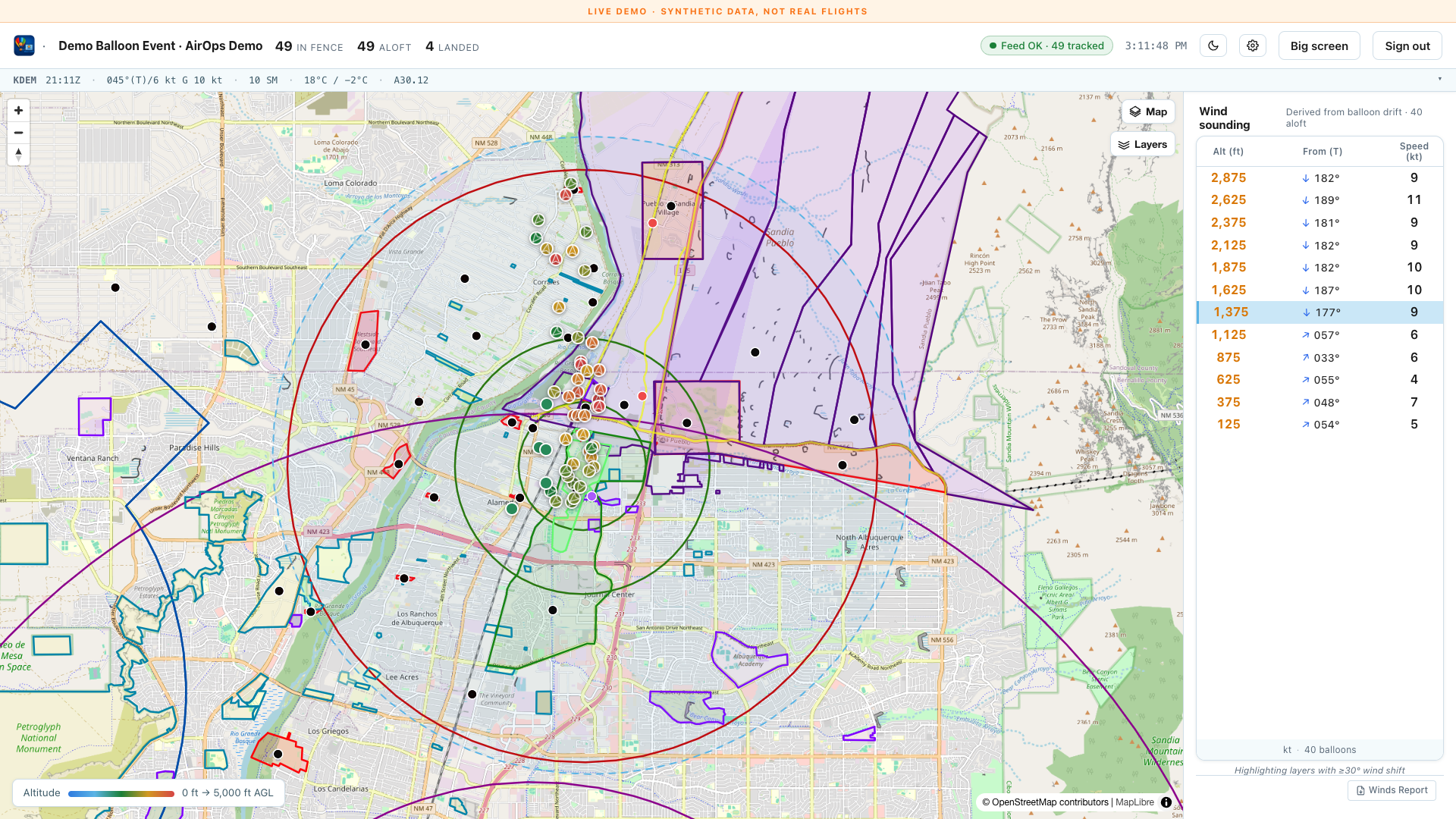
Live Tracking Map
Real-time balloon positions with drift arrows, stable IDs (B1, B2…), and geofenced event areas. Streets, Satellite, or Hybrid basemap. True/Magnetic north toggle. Light & dark mode.
LiveLive tracking, wind sounding, and flight data — purpose-built for hot air balloon operations.
Built by the team behind AirShare — purpose-built for balloon events.
Built by Pilots · Tested in the Field · Try it at /e/demoDrop a pin and set a radius, or draw a polygon. Define your event window — dawn patrol to mass ascension.
Every AirShare pilot inside your boundary is automatically included. No setup for them, nothing to install.
Live map, live METAR, live wind sounding derived from balloon drift. Hodograph and sounding chart update every time a balloon climbs through a new layer.
Surface wind spikes? Gust spread widening? See the trend, not yesterday’s METAR.
Track count, altitude bands, where the fleet is drifting — catch a developing issue early.
Pilot Declared Emergency or a weather event — your staff sees position and altitude immediately, no radio relay required.
Real-time balloon positions with drift arrows, stable IDs (B1, B2…), and geofenced event areas. Streets, Satellite, or Hybrid basemap. True/Magnetic north toggle. Light & dark mode.
LiveAltitude-layered wind data derived from actual balloon drift. Includes a hodograph chart and AFWA-style speed/direction sounding chart that updates continuously as balloons climb.
DifferentiatorUp to 4 airport weather stations displayed live in the dashboard header. Temperature, dew point, wind, visibility, and altimeter — refreshed automatically.
Upload airspace files, event boundaries, or task polygons in the admin. Toggle layers on the dashboard. Click any polygon to view its placemark name and description.
One-click report generation: event info header, METAR, live map snapshot, hodograph, and wind sounding chart on page 1 — full wind data table on page 2.
Fully responsive — full-screen map on phones with the wind sounding panel sliding up from the bottom. Works on the ops table or in the launch field.
Because the balloons are doing it for you. AirOps continuously infers winds aloft from actual balloon drift across the fleet — so your sounding is current, local, and updated every time a balloon climbs through a new layer. No theodolite, no helium, no separate launch.
Multi-day, multi-launch events where hundreds of balloons share the airspace. Keep eyes on the boundary, the winds, and the day's record.
Hare-and-hounds, key grabs, declared goals. Replay the flight after scoring, export tracks, settle the timing in seconds.
Instructor camps and student weekends. Watch the fleet, debrief with the replay, build a wind picture across the whole training area.
The people whose job is to make the call. AirOps gives them the same picture in front of them.
Great for smaller club events and local meets.
The full toolkit for festivals and race events.
Unlimited scale, custom branding, priority support.
No. AirOps consumes the live position feed already produced by AirShare. If a pilot is using AirShare and is inside your event boundary, they're on your dashboard. No new app, no new login.
Yes — visit /e/demo for a live demo with 50 simulated balloons over Albuquerque Balloon Fiesta Park, complete with wind sounding, METAR, drift arrows, and a box-wind profile. No login required.
No. The dashboard anonymizes pilots by default — you see stable balloon IDs (B1, B2…) inside your boundary, not names or personal information. AirOps is for situational awareness and flight operations, not enforcement.
AirOps continuously infers winds aloft from actual balloon drift across the fleet. As balloons climb through each altitude layer, their speed and heading update the sounding panel — giving you a live hodograph and AFWA-style chart without a separate PiBal launch.
The Winds Report is a one-click PDF export: page 1 includes event info, METAR, a live map snapshot, the hodograph, and the wind sounding chart. Page 2 contains the full wind data table by altitude. Pro and Enterprise plans include this feature.
Yes — wherever pilots are using AirShare. METAR coverage depends on the local aviation weather network; if there's no nearby station, surface conditions can be supplied from your own sensor or skipped.
For most single-site events, a two-week heads-up is comfortable. Festivals with custom boundaries, KML overlays, or Enterprise branding: please reach out at least 6—8 weeks ahead.
AirOps gives event staff better information faster — wind aloft derived from balloons actually flying, surface conditions, fleet position, trends. It supports decisions; it does not replace pilot judgment, FAA guidance, or qualified flight-following services.
Founding customers get hands-on setup and a direct line to the team.